

Welcome to the March 2026 edition of our environment, social, and governance (“ESG”) monthly newsletter. In this issue, we highlight key regulatory updates, policy changes, and recent judicial decisions that are shaping India’s environmental compliance landscape. From plastic waste rules amendments to important rulings of the Supreme Court, these developments have direct implications for your business operations.
Updates from Sarthak on ESG
This March, our team was proud to be part of a landmark moment at the Ghaziabad CSR & Sustainability Conclave 2026. The Conclave served as the platform for the official release of Decarbonizing District: Unlocking the Synergy between CSR and India’s Emerging Carbon Framework, a first-of-its-kind knowledge paper jointly developed by Saarthak Collective, Sarthak Advocates & Solicitors, and Centre for Grower-centric Eco-value Mechanisms (C-GEM) . This report was officially released by Shri Abhinav Gopal (IAS), Chief Development Officer, Ghaziabad, in the presence of a distinguished group of industry and ecosystem leaders.
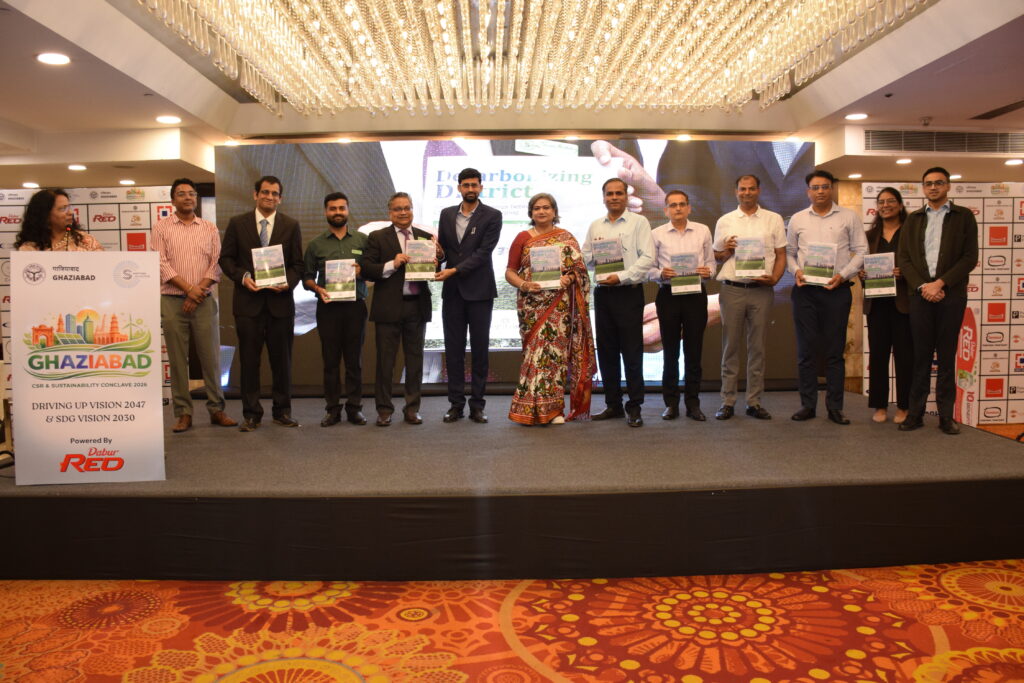
At its core, this report argues that districts like Ghaziabad can become engines of India’s carbon transition by aligning corporate capital, regulatory frameworks and local governance into a coherent ecosystem. It examines the evolving global and national carbon architecture, the strategic implications for Indian corporates, and the role of hyper-local visibility and verification in unlocking credible climate action. More importantly, it advances a practical thesis: that district-led, climate-aligned investment models can simultaneously strengthen regulatory compliance, corporate competitiveness, and community resilience.
Regulatory Alerts
The Central Pollution Control Board (“CPCB”) has issued three sets of show cause notices (“SCNs”) under Section 5 of the Environment (Protection) Act, 1986, targeting non-compliance with extended producer responsibility (“EPR”) obligations under the Plastic Waste Management Rules, 2016. SCN 1 targets Producers, Importers and Brand-owners (“PIBOs”) by asking them as to why the environmental compensation (“EC”) amount for not fulfilment of the shortfall EPR target of Financial Year (“FY”) 2022 – 23 shall not be levied on them in view of non-fulfilment of EPR obligations. SCN 2 targets PIBOs by asking them as to why EC amount for not fulfilment of the shortfall EPR target of FY 2022-23 and non-submission of annual return fees shall not be levied on them. Further, SCN 3 directs Producers to pay the annual return submission fees amount in view of non-filling of annual return for the FY 2022 –23.
The CPCB has issued three sets of SCNs to producers and recyclers under the Hazardous and Other Wastes (Management and Transboundary Movement) Amendment Rules, 2022, concerning obligations under the Waste Tyre EPR framework. SCN 1 targets Producers by asking them as to why the EC amount for not fulfilment of the shortfall EPR target of FY 2022 – 23 shall not be levied on them. SCN 2 targets Producers by asking them as to why the EC amount for non-submission of annual return shall not be levied on them in view of non-submission of annual return for the FY 2022 – 23, 2023 – 24 and 2024 – 25. Further, SCN 3 targets Recyclers by asking them as to why the EC amount for non-submission of annual return shall not be levied on them in view of non-submission of annual return for the FY 2022 – 23, 2023 – 24 and 2024 – 25.
The Ministry of Environment, Forest and Climate Change (“MoEFCC”) has notified the Plastic Waste Management (Amendment) Rules, 2026. Among other things, this amendment exempts the producer’s targets for mandatory use of recycled plastic in plastic packaging in cases, where use of recycled plastic in plastic packaging is not permitted.
The MoEFCC has notified the draft amendments to the Environment Protection (End-of-Life Vehicles) Rules, 2025 which the Central Government proposes to make. The objections or suggestions which may be received from any person in respect of the said draft amendments will be taken into consideration by the Central Government.
During a flagship event of the Government of India, the Union Minister for Power & Housing and Urban Affairs launched the Indian Carbon Market Portal, a central platform for implementing and administering the Indian Carbon Market.
The CPCB has issued Guidelines for Storage and Handling of Waste Solar Photo-Voltaic Modules or Panels or Cells under E-Waste (Management) Rules, 2022. These guidelines are intended to provide technical guidance with respect to transportation, handling and storage of waste solar photo-voltaic panels or modules or cells including their components, consumables, parts and spares in an environmentally sound manner which shall protect the health and environment. These guidelines shall be applicable to the producers, manufacturers, recyclers of waste solar photo-voltaic panels or modules or cell.
The CPCB has issued the Guidelines for Imposition of Environmental Compensation (EC) under the “Hazardous and Other Wastes (Management and Transboundary Movement) Second Amendment Rules, 2023”. These guidelines outline the details on violations, and methodology for calculating EC on the entities for various violations of provisions of the rules along with the enforcement tools.The MoEFCC has notified the Van (Sanrakshan Evam Samvardhan) Amendment Rules, 2026. Through this amendment, in addition to every proposal verified in the field by the Divisional Forest Officer concerned, field inspection shall be simultaneously undertaken for every proposal that involves more than forty hectares of forest land by the Conservator of Forests or Chief Conservator of Forests or Regional Chief Conservator of Forests holding charge of the concerned forest circle.
From the docket
In Indian Oil Corporation Ltd. v. Deepak Sharma and Ors., the Hon’ble Supreme Court of India (“Supreme Court”) while setting aside the orders of the National Green Tribunal (“NGT”) has held that an adjudicatory authority cannot blindly adopt the conclusion of a fact-finding committee constituted to aid in deciding the issues agitated before it; which decision has to be of the authority and not that of the committee.
In Narender Bhardwaj v. M/S 108 Super Complex R.W.A. & Ors., the Supreme Court has held that the NGT had no jurisdiction to direct removal of an alleged encroachment and alleged illegal construction which was raised in violation of the laws not specified in Schedule I to the National Green Tribunal, 2010 (“NGT Act”).
In Naveen Solanki and Another v. Rail Land Development Authority and Others, the Supreme Court has held that a land which has been earmarked for execution of a project under an approved Master Plan, which is not a forest land as per revenue record or neither a declared forest nor fulfils the requirement of a deemed forest at the time of coming into force of the said Master Plan, cannot be subsequently declared a forest or a deemed forest.
In Bhopal Gas Peedith Sangharsh Sahyog Samiti v. Union of India & Ors., the Supreme Court has held that the appropriate recourse for the petitioner to flag the issue of its apprehension of mercury leakage in future would be to move an application before the High Court of Madhya Pradesh. The controversy pertains to apprehension of mercury in the dumped residual ash generated after the incineration of toxic material arising from the Bhopal Gas Tragedy.
In State of Telangana v. Anantha Seetharam Reddy, the High Court of Telangana has stayed an NGT order halting the State of Telangana (Project Proponent) from proceeding with any activity concerning the Uma Maheshwaram Lift Irrigation Project. This order has been passed in a Writ Petition filed by the State of Telangana against this impugned NGT order on the ground that the NGT has passed this impugned order without notice to any of the respondents including the State of Telangana.
In Bharat Petroleum Corporation Limited v. Central Pollution Control Board & Ors., the Principal Bench of the NGT has dismissed the Appeal filed by Bharat Petroleum Corporation Limited (“BPCL”) against a CPCB’s order through which the CPCB had imposed an Environmental Compensation (“EC”) of INR 1,00,00,000/-,(Rupees one crore) on BPCL for not installing the vapour recovery system (“VRS”) at storage terminal and had further directed closure of the operation of the concerned terminal if the EC was not deposited within 15 days. While dismissing this Appeal, on request of BPCL, the NGT has extend the time for paying the EC amount by four weeks.
In Shahu Shivaji Mokashi v. State of Maharashtra & Ors., the Western Zone Bench of the NGT has directed the Project Proponent to deposit INR 50,10,000/- (Rupees Fifty Lakh Ten Thousand) as the environmental damage compensation (“EDC”). In this matter, the Project Proponent was alleged to have discharged its molasses in the water of Hiranyakeshi river, thereby, causing river pollution and groundwater pollution and posing serious health hazards to the local inhabitants, animals etc.
In National Environment Care Foundation v. Mangalore Smart City Limited & Ors., the Southern Zone Bench of the NGT has disposed of all three applications relating to the alleged violations by the Mangaluru Smart City Project Limited by directing it to strictly adhere to the Coastal Regulation Zone Notification 2011, the conditions imposed in the Coastal Regulation Zone (“CRZ”) Clearance, and all other applicable statutory provisions.
In Dillip Kumar Samantaray v. State of Odisha & Ors., the Eastern Zone Bench of the NGT has issued notice in a matter alleging environmental violations by the Alumina Refinery Unit of M/s Vedanta Limited.
In Shakil Saifi v. State of Uttar Pradesh & Ors., the Principal Bench of the NGT has issued notice in an Application where the Applicant has claimed compensation under Sections 15 and 17 of the NGT Act for the death of his family members due an explosion in an illegal firecracker manufacturing unit.
In M/s Sumridhi Aluminum Pvt. Ltd. v. Commission for Air Quality Management in National Capital Region and Adjoining Areas & Ors., the Principal Bench of the NGT has permitted the Appellant to file an appropriate representation or compliance report with the Commission for Air Quality Management (“CAQM”). On receipt of the said compliance report, the CAQM has been directed to verify it within a week’s period and if the needful is found to be done, the CAQM will pass a necessary order. This Appeal was filed against a closure order issued by CAQM.
In People Charioteer Organization v. Home Ministry & Ors., the Principal Bench of the NGT has issued notice in an Application where the issue pertains to air pollution in different cities across India.
In Hanumant Uttam Govekar v. GCZMA & Anr., the Western Zone Bench has allowed the Appeal and set aside the Goa Coastal Zone Management Authority (“GCZMA”) order directing demolition of an RCC Structure.
That’s all we have for you this month.
From amendments to plastic waste rules and end-of-life vehicle rules, to judicial directions on adjudicatory authority and imposition of environmental damage compensation, March has been a busy month for India’s environmental compliance landscape. We hope that this ESG update will prove useful for you and that you will be watching out for these again next month.
Disclaimer
The content provided in this newsletter is intended for general awareness and should not be considered as legal advice. Readers are advised to consult with a qualified legal professional regarding any specific issues mentioned herein. If you have any questions about any of these developments or would like to see something different next month, reach out to us at knowledge@sarthaklaw.com.